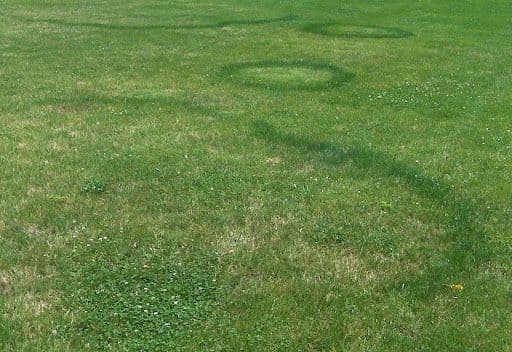
Fairy Ring disease is recognized in early summer by the appearance of dark green, circular bands. Most of the time, Fairy Ring is formed in a circular pattern, but it’s also common to see an unformed circle. Bands can vary in width from 10-20 cm, and rings will vary in diameter up to 50 yds. During periods of wet weather, the causal fungus gives rise to fruiting bodies, commonly known as mushrooms and toadstools, along the circumference of the rings.
Fairy ring is caused by a fungus called Marasmius oreades, also known as the Fairy Ring Mushroom. The fungus is contained within the soil, as deep as 30 cm below the surface, and creates mushrooms that can range in size from a few inches to several feet in diameter. This fungus attacks at a central point and grows outward along the inner margin of the rings, where the grass becomes very weak and often dies out temporarily. In small rings, the weakened grass may occupy the entire central area. The fungus feeds on dead organic matter in the soil and can also affect the growth of the grass, causing it to be thicker or thinner than the surrounding grass.
Fairy Ring can be difficult to control. In some cases, you may be able to remove the affected soil and re-seed or sod the area with a more disease resistant variety of grass. However, depending on the size of the infestation and the scope of the damage, other forms of control may be necessary.
A thick, healthy, well-maintained lawn is the best line of defense. Here’s how you can adjust your beneficial cultural practices to reduce the spread of Fairy Ring disease:
Your local Weed Man professional may be able to offer other solutions and recommend the best form of treatment that is available to improve the conditions of your lawn.
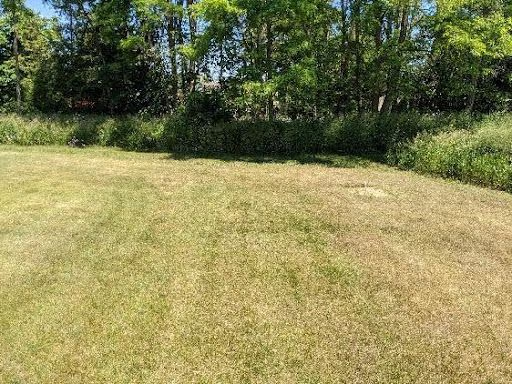
Drought stress refers to the negative effects on a lawn when there is not enough water available for the grass to properly grow and thrive. This can cause the grass to turn brown and dormant, while al...
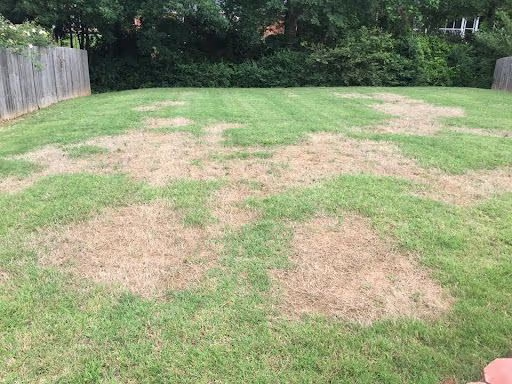
Take-All Patch, also called “Root Rot,” is a common fungal disease that affects the roots of grass plants, particularly in golf courses and lawns. It attacks lawns that are already stressed, weakened,...
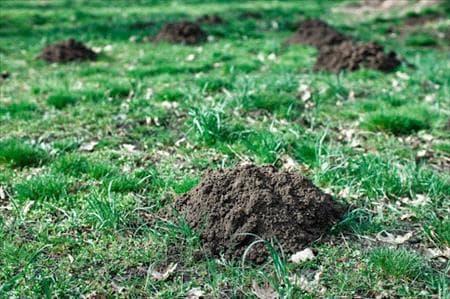
The adult mole is a small, burrowing mammal, commonly found in lawns and gardens. It has dark gray or brown velvety fur and a cylindrical body that is 15 to 20 cm (5 to 8 inches) long. It has small ey...

