
Written By
Dr. Brad
Published On
July 22, 2026
‘Come back again when you can’t stay so long.’ A favorite muse of my grandfather, and I would wager many grandparents.
While intended as playful banter, it doesn’t take long to realize the disruption in peace three girls under the age of nine may cause. Maybe less of a loving visit and more of a temporary infestation, the key being temporary.
On a most recent visit, the infestation of tiny humans noticed how many of grandma’s plants appeared to be eaten by something. This observation was quickly followed by piercing screams that would suggest a grizzly bear bounded out from behind a rose bush. Again, disruption of peace.
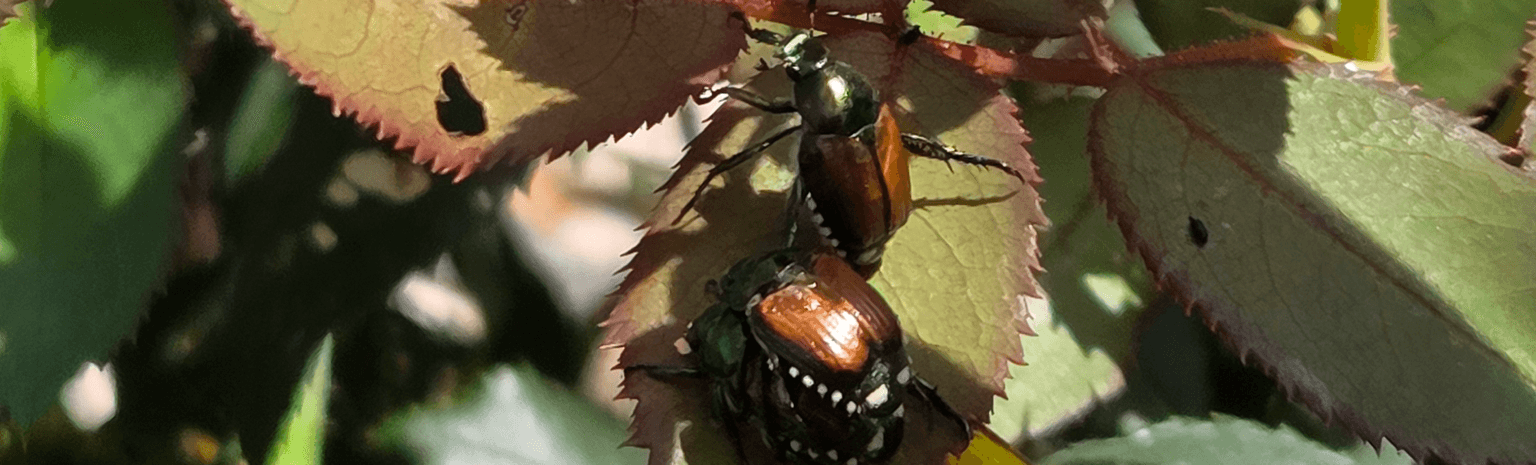
The culprits, Japanese beetles. One of thousands of invasive species accidentally introduced to the United States over time through worldwide travel and shipping. Japanese beetles were introduced in 1916 through contaminated Japanese nursery stock. The adult beetle itself does not damage turfgrass, but it does forage on a wide variety of plant species, including field crops, vegetables, trees, and ornamental plantings. Usually only cosmetic damage over a few weeks, but damage can be extensive. These adults then lay eggs in the soil that hatch into grubs, which can cause significant damage by eating grass roots, which may result in permanent damage. And then secondary damage by mammals as they dig up the grass and prey on these same grubs that are feeding just below the surface.
Control of these insects is critical in avoiding damage. One of the most common myths regarding this control is the implementation of pheromone traps. These traps utilize specific chemicals called pheromones to communicate to insects, attract them, and trap them. Adult beetles can be attracted from hundreds of yards away, causing a spillover effect, where more beetles are attracted to the property to feed than can be trapped. Or, more concerning, actually attracting more beetles overall than would have visited the property without the trap being implemented. The University of Minnesota has shown that of beetles attracted to the site, 75% of the beetles are trapped, while the remaining 25% are free to pillage the local vegetation.
Unlike my tiny humans, this beetle infestation is here to stay, making control often necessary. There are very effective methods to control the adults and grubs through conventional insecticides when applied with proper timing. If insecticides are not an option, physical barriers on ornamentals may be your best option, but this will still leave the grass at risk as grubs feed on roots after adult egg laying. Pheromone traps should only be used as observation tools, not an eradication tool. And if you must use the trap, it may be best implemented in your neighbor’s yard.
Written By
Dr. Brad
Published On
July 22, 2026

Calling all customers! Help us plant the seeds of kindness and give a much-needed hand to our neighbors. It’s time for our 3rd Annual Grassroots Giving food drive.

Calling all customers! Help us plant the seeds of kindness and give a much-needed hand to our neighbors. It’s time for our 3rd Annual Grassroots Giving food drive.
Calling all customers! Help us plant the seeds of kindness and give a much-needed hand to our neighbors. It’s time for our 3rd Annual Grassroots Giving food drive.

