Written By
Ryan LeClaire
Published On
May 7, 2026
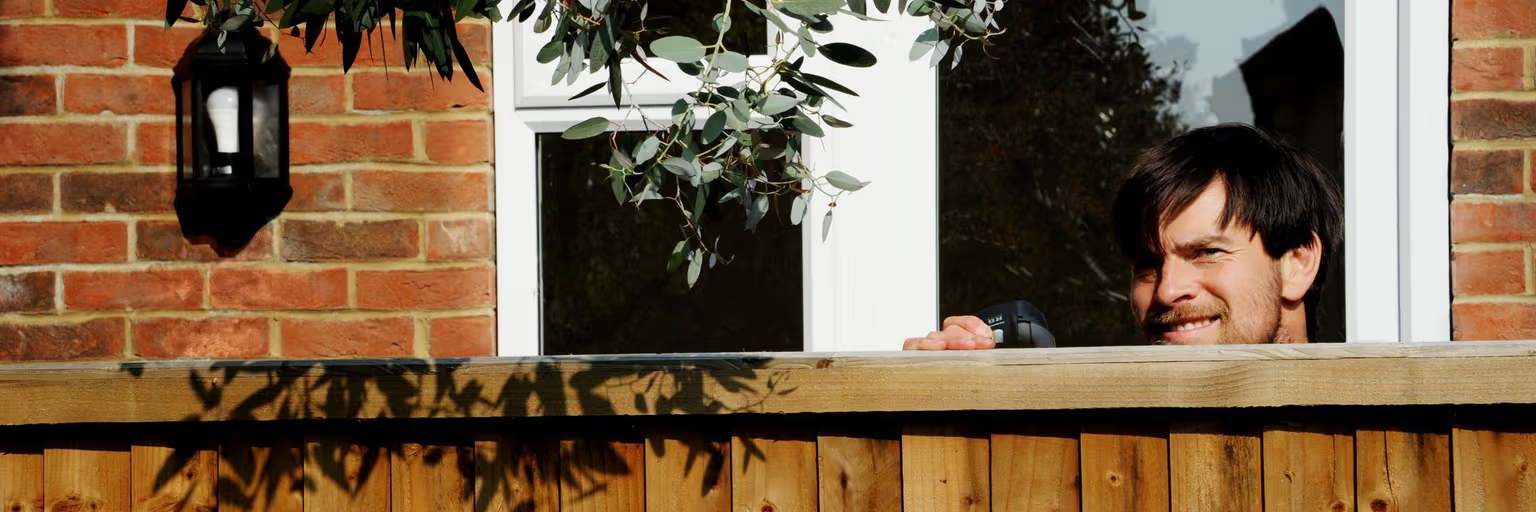
This is a safe space, so you can be honest. Do you feel like you’re competing against your neighbour's lawn? If you do, you’re not alone. In fact, you’re in the firm majority.
Weed Man conducted a survey and discovered that 76% of homeowners feel like they’re competing with their neighbour’s lawn, while only 25% openly admit to engaging in the lawn wars. So if lawn problems like dandelions or crabgrass raise your blood pressure, you’re far from alone.
If your neighbour’s lawn looks better than yours, it’s often not your fault. And it may not even be that they’re spending more money or working harder on their yard. It may be that you’ve got undiagnosed lawn problems, or you’ve been given bad advice over the years.
With that in mind, let’s take a look at six very common (and very fixable) reasons that your neighbour’s lawn looks better than yours, and how to fix any lawn problems that are keeping you from winning the neighbourhood.
You may have heard that watering in the afternoon is not great because the water can evaporate in the midday heat. But did you know that watering in the afternoon can actually attract chinch bugs?
It’s true! Chinch bugs are attracted to warm and moist environments, so watering in the afternoon can actually invite these lawn destroyers.
You will want to get in the habit of watering deeply, but infrequently, in the morning before the day heats up.
Depending on your grass type, your lawn needs:
We have another blog that walks you through the best way to water your lawn.
Putting green style close-cut grass may look great on the PGA Tour, but it’s really bad for homes.
Cutting your lawn too short can leave it vulnerable to sun damage, diseases, and pests.
As a good rule of thumb, you will want to trim your grass to about 4” (or 10 cm) to ensure it has enough length to protect your soil, and you never want to remove more than one third of the blade when you mow.
You may also want to leave a little more length during peak summer months for added protection from the sun and heat.
However, these are just guidelines. Your best bet is to contact a local lawn care expert who has firsthand experience with your specific grass type and knows the local weather.
You can learn more about how to mow like a pro by reading that blog.
Trust us when we say that if you’re struggling with a weed infestation, the answer to your problems is not on the shelf of any hardware store, particularly if you’re dealing with an aggressive and persistent weed like crabgrass.
Despite the big promises that these so-called weed-killers make, they won’t solve the problem over the long term, and you stand a good chance of harming the healthy grass around it.
It’s crucial to correctly identify the weed, and that can be tough to do sometimes. Crabgrass can often be mistaken for tall fescue, quackgrass, goosegrass, johnsongrass, and nimblewill. Treatments will vary, so you need to learn how to identify lawn problems before you can properly solve them.
It’s not about killing the weeds you see right now. It’s about solving the underlying issues that are leaving your lawn open to infestation in the first place.
If you’re experiencing unwanted weeds, don’t let them take over! Start right now by contacting Weed Man and answering a few quick questions about what your lawn is going through.
Do you have soil drainage problems in your yard? Do puddles rest on your grass for hours after a rainstorm? Can you hear your footsteps when you walk on your lawn? All of these are signs that your soil is compacted.
Soil compaction is a problem because it means that your soil isn’t absorbing the water or nutrients it needs to thrive. You could water or fertilize twice as much as your neighbours and still only get half the results.
A professional aeration can loosen up your soil and finally let it breathe!
Over time, foot traffic and mowing compact your soil, making it hard for roots to grow. Aeration breaks up that compaction so your grass can thrive. Aeration pulls out small plugs of soil, opening channels that allow air, water, and nutrients to reach your grass roots. These plugs (or “cores”) are left on the surface of the lawn until they break down naturally.
You can do all the right things. You can mow perfectly, water optimally, and fertilize flawlessly. And you will still not get the results you want if your soil’s pH levels are off.
Your soil’s pH is a measurement of these ions:
Any number too far in either direction is going to lead to problems.
Knowledge is power. Local experts know local lawns, local conditions, and especially local soil. Weed Man is made up of a vast network of local, experienced technicians who know just what your lawn needs to grow lush and healthy.
A lot of people assume that the thin layer of dead grass (and other organic materials) is keeping their soil from getting the air, sun, water, and nutrients it needs to thrive. While that may be true in a lot of cases, the opposite can also be true.
Stripping away too much thatch can also leave your soil exposed to sun, pests, and lawn diseases.
How much thatch do you want? You don’t want to let thatch get any thicker than 1/2 to 3/4 of an inch (1-2 cm), but anything below that should be fine.
Unless you’re dealing with a lawn that has been neglected for some time, you don’t need to work too hard to remove thatch.
A good fan raking in the spring should be all you need. No need to overthink it or overdo it.
Who should you call to fix your lawn problems? We’re standing by to be drafted onto your team. We can help you with any of the issues we discussed today with professional treatments and expert advice tailored to your lawn.
“Weed Man has been a saving grace for me this summer! As a single mom, I have always struggled with keeping up with the weeds in my front rock area. This summer, I had Weed Man come out once a month to spray the weeds. If I saw any pop back up, they would come out a second time. They are always on time, very communicative and polite. I would highly recommend them and we will definitely be using them in the spring again!” - A 5-Star Google Review.
You can start right now by telling us a little bit about your lawn.
Written By
Ryan LeClaire
Published On
May 7, 2026

Why Are Weeds Suddenly Growing in My Lawn?


Calling all customers! Help us plant the seeds of kindness and give a much-needed hand to our neighbours. It’s time for our 3rd Annual Grassroots Giving food drive.
Calling all customers! Help us plant the seeds of kindness and give a much-needed hand to our neighbours. It’s time for our 3rd Annual Grassroots Giving food drive.

